Writing Revolutions

From Notebook to AI
If you've never written a book, you probably picture an author sitting alone in a quiet room, fingers dancing across a keyboard until a finished manuscript appears. It's a comforting image—but it has never been entirely true. Every book I've written has been shaped by editors, critique partners, beta readers, and the encouragement of my wife and others. The people around me changed over the years, but so did the tools.
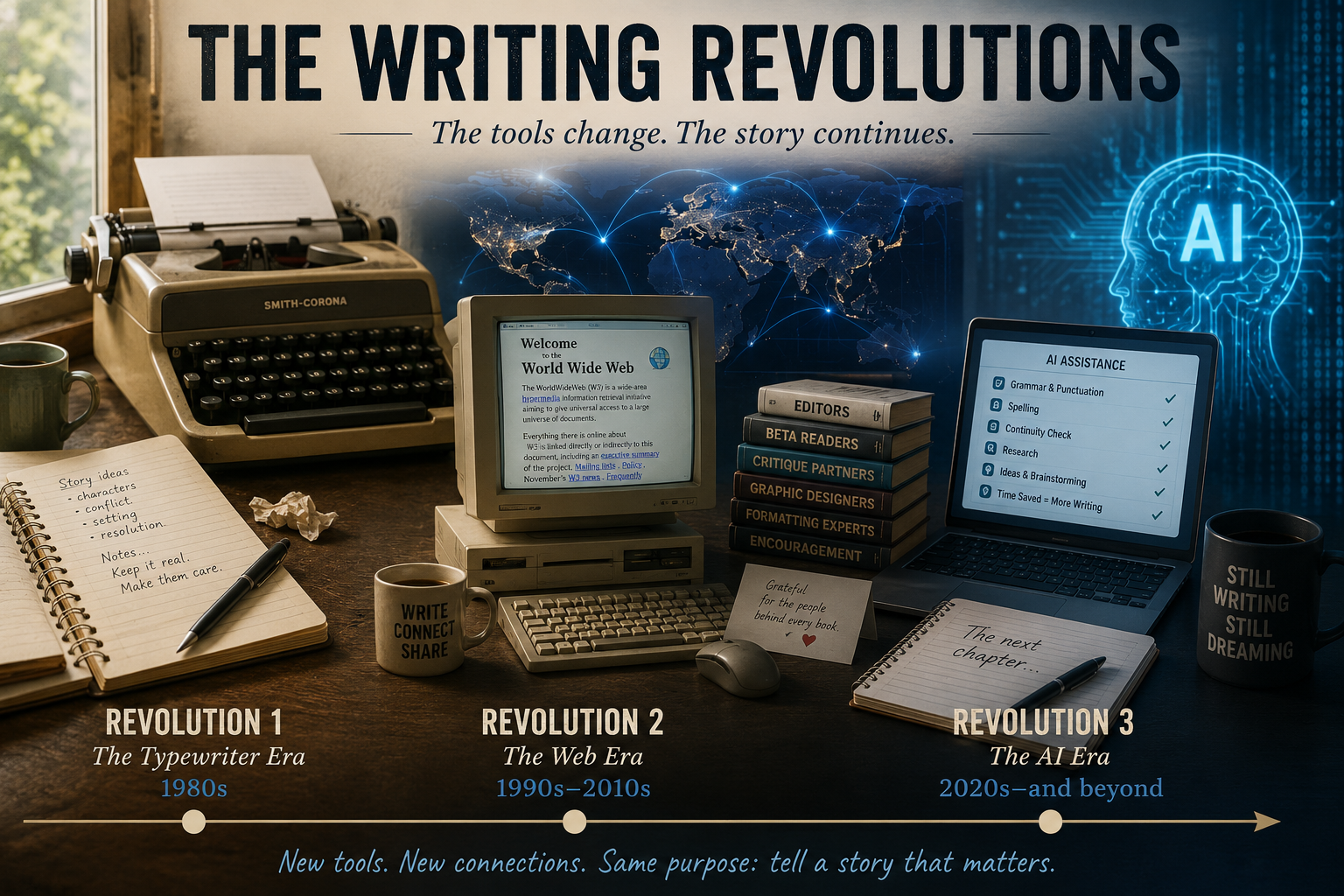
In the 1980s, I'd fill yellow legal pads with handwritten pages before sitting down at my typewriter to transform them into something that resembled a manuscript. Every correction meant white-out, erasers, or retyping entire pages. It was simply the way books were written.
By the early 1990s, a technological revolution was brewing. Tim Berners-Lee proposed the World Wide Web. Later, he gave it to the world without charging royalties. The Web became one of history's greatest innovations, in part because Berners-Lee chose not to create an information toll road but instead built a way to speed along the growing information superhighway. For the first time, writers weren't limited to the people who lived nearby. Suddenly I could send a manuscript across an ocean in seconds instead of weeks.
In the years that followed, my writing moved from a typewriter to an Osborne CP/M computer, then to a succession of DOS and Windows machines. Each new tool shaved a little more time off the process. Then in 2013, Through Many Fires became my first Kindle number-one bestseller. Looking back, I realize that success depended on people I'd never met in person. My graphic designer lived in the Czech Republic. My formatter lived in India. Beta readers lived on three continents. The Web had quietly turned publishing from a local effort into a worldwide collaboration. That was the first technological revolution.
Surely, I thought, we'd reached the end of the revolution. Publishing had become global. Books could be edited, formatted, and delivered anywhere on Earth in minutes. How much easier could it possibly become?
Then the next revolution burst upon the world in 2022 when artificial intelligence (AI) became widely available. I was curious and, over the next year, used it more and more. Today, I use it to check grammar, punctuation, spelling, and continuity in my stories and for writing research. I still do the writing, but many tasks that once took hours, days, or even weeks, such as graphic design, now take mere minutes.
I still keep a notebook within arm's reach. Ideas still begin with ink on paper. But the typewriter is gone, and I suspect today's tools won't be the last to change the way I write.